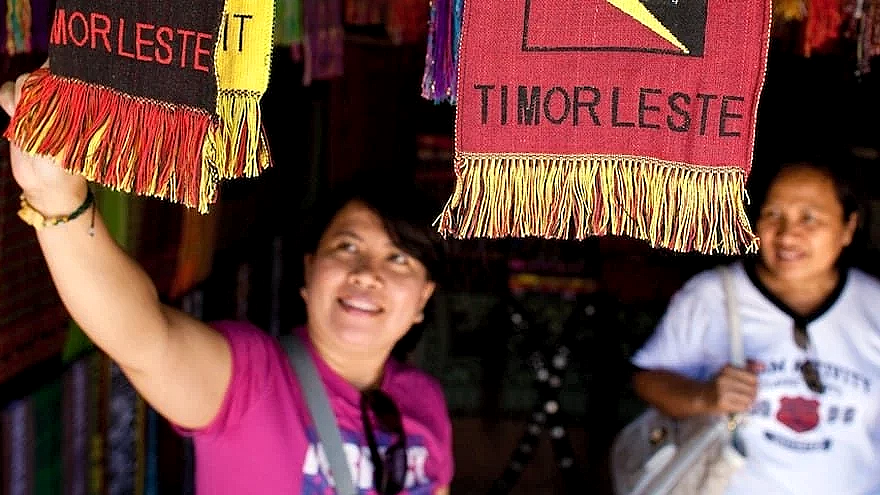
The issue of Timor-Leste joining ASEAN has become the highlight during ASEAN Summit and Foreign Ministers’ meeting this year. During a recent visit to Malaysia, Timor-Leste President and Nobel Peace Prize laureate José Ramos-Horta reaffirmed his confidence that the country will officially become an ASEAN member in October this year. He is also optimistic that Timor-Leste will achieve significant economic growth in the next two to three years. However, Horta also noted that intra-ASEAN trade is facing stagnation and even signs of decline. Fewer ASEAN companies venture abroad compared to China For years, Timor-Leste has only participated in ASEAN affairs as an observer. But due to its geographic location in Southeast Asia and its historical ties with Indonesia, Timor-Leste has long been deeply engaged in the region’s economic, political, and diplomatic matters. “Seventy percent of Timor-Leste’s goods come from Indonesia, while China is the second-largest trading partner. And trade volume with China is rapidly catching up with Indonesia.” In a media interview at Taylor’s University on June 19, Horta pointed out that Indonesia is currently Timor-Leste’s largest trading partner. In 2024, bilateral trade between the two countries reached US$390 million, marking a 12.31 percent year-on-year increase. According to the Ministry of Foreign Affairs of China, Timor-Leste’s bilateral trade with China in 2023 was about US$340 million. China maintained a large trade surplus, exporting goods such as mechanical and electrical components, cement, steel products, ceramics, textiles, and furniture. Why are the main trading partners of Timur-Leste not its neighboring ASEAN countries, but rather a distant one like China? Horta candidly said, “This is largely due to the lack of genuine entrepreneurial spirit among ASEAN countries. Few ASEAN businesses venture abroad to invest.” In contrast, he sees China as a global investor and trader, whereas ASEAN countries still have room for improvement in this area. “The private sectors in ASEAN have yet to develop the courage, vision, and entrepreneurial drive.” High dependency on ASEAN market That said, when viewed collectively, Timor-Leste’s trade does rely heavily on the ASEAN market. From 2004 to 2022, about 60.2 percent of its imports came from ASEAN countries, mainly Indonesia, Singapore, Vietnam, Malaysia, and Thailand. As for non-oil exports like coffee, they are mainly sold to non-ASEAN markets, with only small quantities exported to Indonesia and Malaysia. Intra-ASEAN trade stagnant Intra-ASEAN trade has been stagnant for nearly the past 20 years. Non-tariff barriers—such as export restrictions—are seen as a major obstacle. According to ASEAN secretariat data, from 2003 to 2023, total goods trade between ASEAN and its internal and external partners grew significantly. However, intra-ASEAN trade accounted for only about 22 percent to 25 percent of total trade—far lower than external trade. Now, with ASEAN nations signing the “2045 ASEAN: Our shared future” Kuala Lumpur Declaration, Horta hopes to witness a more integrated ASEAN economy over the next 20 years. Promoting regional free flow of resources “This includes enabling the free flow of capital, people, and knowledge among our 700 million population. “This will strengthen regional […]
5月前
更多Coffee













 登入
登入
 Newsletter
 联络我们
联络我们
 登广告
登广告
 关于我们
关于我们