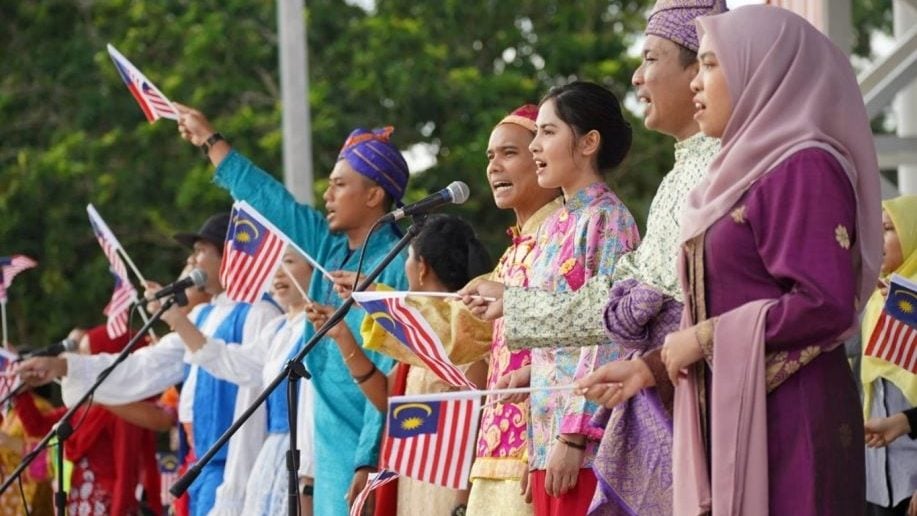
I remember when I was a child taking art classes, our teacher would always ask us to draw the national flag during the National Day month. Back then, the children might not have accurately sketched the actual design of the Jalur Gemilang, but with great enthusiasm, we poured our patriotic feelings onto the blank paper, each expressing creativity in our own way. In that moment, the children’s sense of patriotism was quietly awakened. They were bold and full of love for the country. No one would scold them for drawing a flag missing a stripe or a corner. Their creativity came purely from their heart not from rigid pressure imposed by adults. Later, the late patriotic singer Sudirman Arshad, during the closing ceremony of the 15th SEA Games in 1989 at the National Stadium, entered the venue wearing an outfit made of the national flag, shouted “Merdeka” three times and sang “To Know Malaysia is to Love Malaysia”, uniting the patriotism of both the audience in stadium and television viewers. No one accused him of “desecrating” or offending the beloved Jalur Gemilang. That was the golden era of Malaysia, when people wrote patriotic songs one after another. At the time, love for the country stemmed from heartfelt recognition, not fear of punishment. In the name of patriotism, we established guidelines for the use of the Jalur Gemilang. While the intention was to guide citizens to respect the national flag, the unintended effect was planting a sense of fear around its use, gradually suppressing people’s natural creativity and enthusiasm. People now fear that a small mistake in displaying or designing the national flag might lead to irreversible public outrage and punishment. The desire to show patriotism might instead become the spark for disaster. I believe that patriots would never maliciously insult, burn, desecrate or provocatively display the national flag. But for honest mistakes, we should respond with understanding and compassion, offering the offenders opportunities to learn and rectify—not treating them as treason. Recently, Malay tabloid Sinar Harian sparked a controversy when it re-used an old design template while creating an infographic for the new Inspector-General of Police, Datuk Seri Mohd Khalid Ismail, and failed to remove outdated information. In the past, media that made such errors would promptly clarify and correct them; if the mistake was severe, they would issue a public apology. The matter would usually settle soon after. Today, however, the norm is immediate police reports, intense public backlash and investigations that may lead to senior editors being suspended or dismissed. This toxic culture has left media workers living in deep fear and severely undermines the development of press freedom. Ensuring accuracy and quality contents are the professional duties of journalists. But we are all human—mistakes can happen. Society should give media space to correct, improve, and raise their standards. Chief editors and senior editorial teams work under tremendous pressure. Every day, they must complete editing and decide within tight deadlines, bearing full responsibility for headlines, texts and images. […]
5月前

The Democratic Action Party (DAP) has just concluded its most intense party election in history, amidst the tussle over keeping or sending off “the god in the party.” DAP officially enters the era of Loke Siew Fook and the Lim dynasty comes to an end. However, those who understand the saying of “barren land goes unattended, but once cultivated, many will fight over it”, they must be mentally prepared that the next party election will likely be even more intense. Therefore, party members must remember that the party is strong when it is united and otherwise if it is divided. Party elections are a process of renewal and a test of survival for the party. The decline of MCA (Malaysian Chinese Association), Gerakan and UMNO from their once-dominant positions serves as a mirror for DAP. It must be vigilant against internal fights as these could become the very demons that topple the party. Where will be DAP heading under Loke’s helm? The DAP is no longer an opposition party today. It holds power and enjoys the strongest support from the Chinese community. With this backing, the Chinese have high expectations and hope that the DAP will remain vocal to serve the community However, the rocket has been accused of being too silent when it should speak up on many issues, earning the nickname of “a silent party.” In response to this criticism, Loke strongly denied the accusation in his speech at the party congress, emphasising that the DAP, now a ruling party, must change the way it speaks. “DAP is now part of the government. Our leaders do not only represent the party but also the nation. Therefore, communication should be taking place through dialogues and meetings, with the focus on finding solutions,” he said. Loke is absolutely right—this is how a governing party should function. However, when the MCA was in the government, it adopted the same approach but was criticised by DAP (the opposition then) for being “in power without authority”. History is not just a mirror—it is often an ironic joke. The current position of MCA is extremely awkward. Even though it is now an opposition party, it is still bound by the Barisan Nasional (BN) coalition spirit and has been forced to follow its “big brother” UMNO to join the Unity Government. This feeling of dependence is unsettling—it is technically an opposition party but remains within the government, making it truly a case of power without authority. For the DAP, although it now holds both power and authority, some of its leaders still cannot let go of their hostility toward MCA, seizing every opportunity to criticise and attack the latter, as if they are still stuck in an opposition mindset. As political rivals, both are facing identity crises now. The key difference between MCA and DAP is that MCA openly acknowledges itself as a Chinese-based party, whereas DAP, bound by its “Malaysian Malaysia” ideology, cannot publicly affirm its Chinese identity. Although it relies heavily on […]
9月前
更多Kuik Cheng Kang

















 登入
登入
 Newsletter
 联络我们
联络我们
 登广告
登广告
 关于我们
关于我们