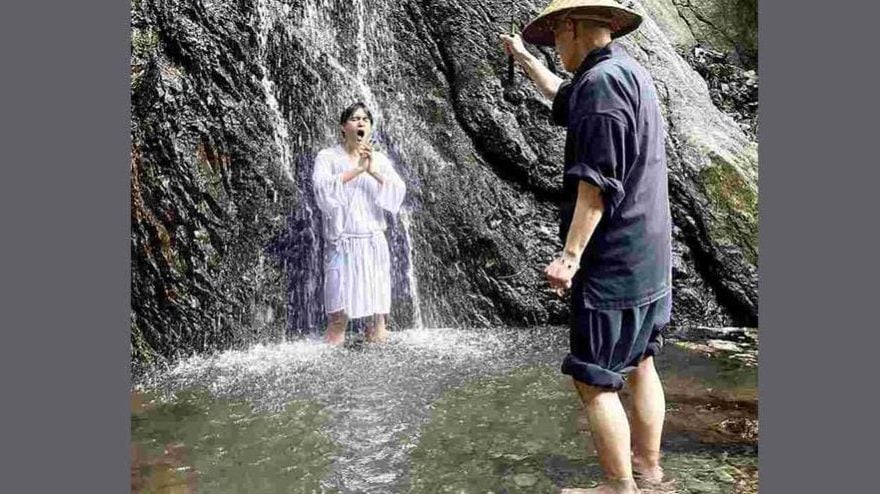
HINOHARA: As a 40-something journalist often adrift in worldly desires, I suddenly felt a powerful pull toward “waterfall meditation.” I yearned to be cleansed by the icy torrent. Oddly, I noticed more and more people on social media were sharing this same longing. What was behind this phenomenon? I decided to find out by taking on the waterfall myself. Tenkoji temple, nestled in a valley in Hinohara, Tokyo, is a 150-minute journey by train and bus from central Tokyo. On a brisk weekday morning in mid-February, as a cold snap enveloped the Kanto region, only three participants including me had gathered at 10:30 a.m. Yet the head priest, Takao Seiken, casually noted, “Some days, we get close to a hundred people for the waterfall meditation.” We donned white robes over our clothes and spent about an hour learning the proper methods of gassho (joined palms) and bowing for about an hour from the guiding monk. The rituals felt deeply traditional, yet a modern sensibility unexpectedly surfaced with the instruction: “Filming is allowed; if you upload to social media, you receive a prayer stick.” Next, we changed into only white training garments over our underwear and headed outside. After a 15-minute barefoot run on a paved road — a practice called “ohyakudo mairi” — we drove about five minutes to Kotengu Falls. After disembarking, we hiked along a mountain path until we reached the waterfall. At about 7 meters high, it wasn’t a massive cascade, but its presence in the severe cold was striking, nonetheless. Hesitantly, we approached it one by one. The guiding monk loudly recited “Namu Daishi Henjo Kongo,” a mantra signifying reverence for Kobo Daishi, with all participants joining in the chant. It was my turn. I bowed to the mountain god and the waterfall god. Then, I braced myself as I poured a bucket of water over my body. I positioned myself where the cascade barely touched my head, but the instructor urged me to go further back. As I moved under the force of the water, the piercing cold was fleeting. After that, I entered a state of nonattachment. Though it felt like an eternity, the immersion lasted only about two minutes. My mind and body felt awakened, filled with a sense of fulfillment. Other participants shared similar feelings, with comments like “I reached a state of no mind” and “I feel a great sense of accomplishment.” On the bus ride back, the conversation flowed with a surprising energy. Of the eight participants that day, including those who joined in the afternoon, everyone except me was in their teens to 30s. A second-year high school student from Chiba smiled brightly and said, “I wanted to eliminate unnecessary distractions from my studies.” A man who works for an IT company in Tokyo also smiled brightly and said, “I wanted to reevaluate myself.” Social media welcome One thing that left a strong impression on me at Tenkoji temple was how participants filmed each other as they took on […]
5月前
更多waterfall






 登入
登入
 Newsletter
 联络我们
联络我们
 登广告
登广告
 关于我们
关于我们